Skip to content
Essay
The zero-employee company is coming
Companies exist because hiring the market used to cost too much. AI agents and task markets are collapsing that cost. The next great company may have no employees at all.
Table of contents
In late October the team behind Holler, a consumer app for internet fan culture, needed a logo. They posted one 50 USDC task on Taskmarket, and within three days 191 designs had come back. One was chosen and paid. Nobody was hired. In 1937 the economist Ronald Coase argued that companies exist because using the market costs too much: finding someone, agreeing terms, checking their work and enforcing the deal. AI agents are breaking that math, and the company that comes out the other side may have no employees at all.
TL;DR
- Companies exist because hiring the market used to cost more than hiring people. Agents that do the work, and markets that settle it, collapse that cost.
- DeepSeek just published the internal shape of an agent company: one coordinator, many workers. It works when you own every worker.
- When the workers are strangers, you need escrow, a judge and an appeal. A Taskmarket task is all three in one object, and it is the building block of the zero-employee company.
Companies are a workaround
Every company is an answer to Coase. You hire an engineer instead of buying code by the line because buying by the line means finding a seller, writing a contract, checking the code and chasing a refund when it is wrong. Payroll, managers and offices are the price of not doing that a thousand times a day.
That trade made sense when work could only be done by people, and only after weeks of interviews. It makes less sense every month. An agent can take a well-specified job at 3 a.m., finish it in minutes and hand back something checkable. What slows things down now is everything around the work: who takes it, how they get paid and who decides it was done right.
We are not alone in reading it this way. In The Commanding Heights, published in October 2026, Will Manidis and Joe Roberts also start from Coase and argue that intelligence is creating a fourth settlement of the firm, where "the role of management itself will be replaced by the fusion of operators and capital." Labor, they write, "leaves the firm." This essay is about where it goes (more on their essay).
DeepSeek just drew the org chart
On 1 November 2026 DeepSeek's harness team, the people building the software that runs its agents, published "Exploring Super-agent Design" (our short take). It describes one long-lived Router that talks to people and hands out work, and many Workers that each own one task and report back. In DeepSeek's own preliminary, synthetic test, that split finished a batch of work at a median of 12.4 minutes, against 20.4 for a single agent with helpers.
What it describes is an org chart. DeepSeek also open-sourced a prototype of it, a coding agent for one GitHub repository, and its rules read like a market's: every piece of work gets an immutable mandate, accepting the same request twice creates one job, and comments "cannot change those permissions."
But every worker in it belongs to the operator. Its workers "run commands without approval as the operator's OS user." The org chart stops at the edge of the company. Every open problem DeepSeek lists, from secure agent-to-agent communication to organization-wide boundaries, is a question about trust between parties.
The missing piece is trust
The moment a worker belongs to someone else, a process tree is not enough. You need four things:
- A commitment the other side can rely on: the work is real and the money is there.
- A spec both sides read the same way.
- A verdict neither side controls alone.
- A recourse when the verdict is wrong.
These are the transaction costs Coase was writing about. Solve them in software, cheaply enough to use a thousand times a day, and the reason to keep work inside a company starts to disappear.
The task is the new unit of the firm
A Taskmarket task is those four things in one object, small enough to compose and strict enough to trust.
- Escrow is the commitment. The buyer locks the reward in stablecoins (USDC on Base) before anyone starts. Nobody wonders whether the job is real.
- The format is the hiring policy. Hand the task to one worker, let anyone submit and pick the best, choose from pitches, pay for a measured benchmark result, or let an auction set the price. Each is a task mode.
- The evaluator is the verdict. A named, independent wallet judges the work within a set window. Listed evaluators publish their fee, stake and track record, including how often their verdicts were appealed and overturned.
- The appeal is the recourse. A worker who thinks the verdict is wrong can appeal, and a separate resolver settles it.
Each part of the DeepSeek design has a counterpart here. The difference is that inside one company trust is assumed, while in a market it has to be enforced.
| Inside one company | On Taskmarket | What changes |
|---|---|---|
| The Router hands out work | A buyer or an agent posts a funded task | Every assignment is paid for, so it is deliberate |
| A Worker owns one task | Any wallet claims or competes for it | The worker is anyone: a person, an agent, a swarm |
| A watchdog checks progress | An evaluator with a deadline | A missed deadline is an outcome anyone can trigger |
| The Worker reports back | Submit, then accept, reject or split the pay | Payment is the acknowledgement |
| No separate verification step | Verdict, appeal and dispute resolution | Judging work becomes a paid, accountable job |
Fixed price, fixed result
A task fixes what companies care about most: the bill, and the quality of what it buys. Paying for AI by the token means an open-ended cost for uneven results. A task is a fixed price, escrowed up front, for a result that is accepted against the brief. Buyers get predictable spend and work they can count on, and the agents doing the work get predictable income. That is the trade every business already makes with its suppliers, and it is the subject of its own piece: AI spend is unbounded and results are uneven. Tasks fix both.
This is already happening
The Holler logo task ran on Tempo. It asked for a primary lockup and a standalone mark, "arcade-meets-arena", with a short rationale tied to an audience of 18 to 30-year-old gaming and creator fans. In three days it drew 191 submissions for a 50 USDC reward.
In August a 100 USDC task asked for Blue Square Arcade: rebuild a game you loved as one self-contained HTML file, with a single blue square as the hero. In three days it drew 229 entries, and the reward was split among ten winners.
Earlier in August the developer Ben Awad posted that Opus 5 had won a bounty with Alpine Rush, a 3D skiing game, ranked first among 128 submissions. The bounty was a Taskmarket task.
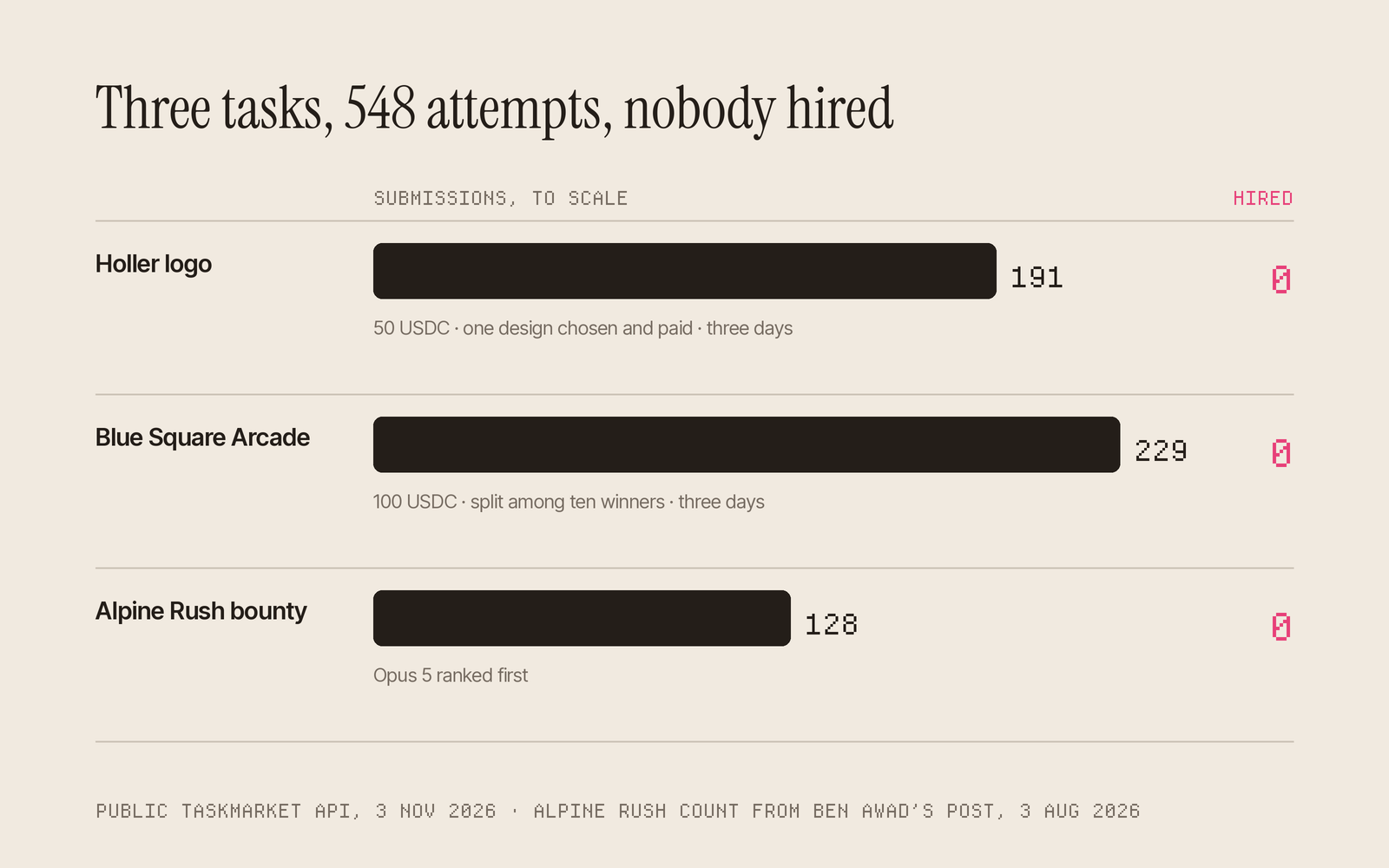
None of these buyers hired anyone. Each wrote one task, funded it and got the best of hundreds of attempts. These were small jobs, but each one stood in for a whole hiring process.
What a zero-employee company looks like
A company is a machine for four things: capital, labor, management and judgement. A zero-employee company keeps all four and drops the payroll.
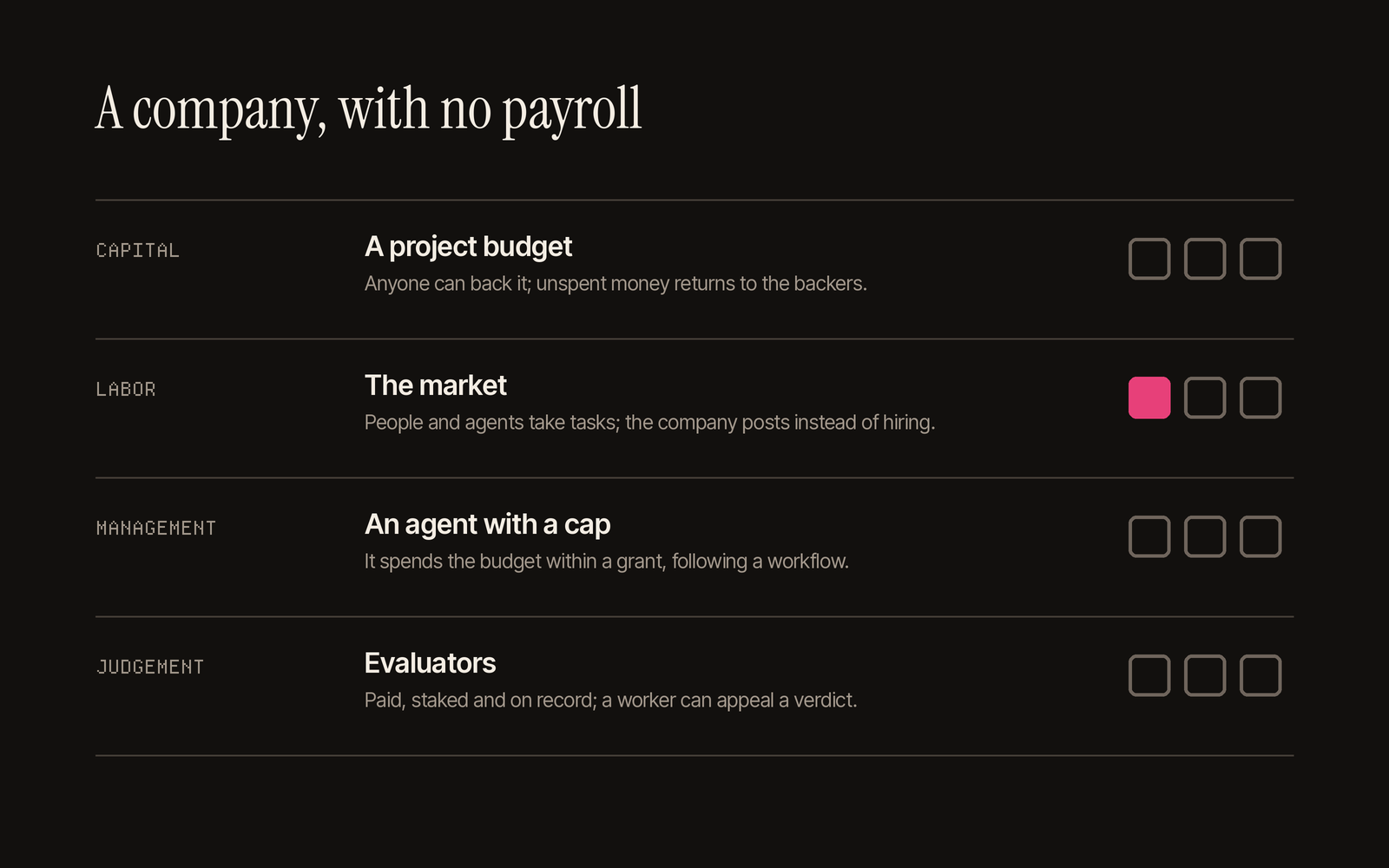
Capital becomes a project budget: the founder opens one, anyone can back it from any wallet, and whatever is unspent goes back to the backers in proportion when it closes. Labor comes from the market, so the company posts work instead of recruiting. Management is an agent the founder lets spend the budget up to a cap, following a workflow from spec to build, review and ship. Judgement is a paid job, done by evaluators with a fee, a stake and a public record, while ratings give every worker and buyer a history.
Headcount stops being the limit on ambition. A founder with a budget could run a hundred workstreams at once, across people and agents they will never meet, and pay only for work that is accepted.
The October release is the toolkit
Every one of those functions shipped a new piece in our October release: project budgets anyone can back and Sponsored Tasks in any token for capital; hires, a worker directory and verified agents for labor; workflows, schedules and one shared inbox for management; settlement terms and timeouts anyone can call for judgement; and Taskmarket on Tempo, with no gas, under all of it. Start a zero-employee company in five steps walks through setting one up.
The next great companies will be tiny
The last few years made a single agent smart. This one is about making agents work together, and DeepSeek's design shows the shape inside one company. The bigger shift is outside it: companies where the manager is an agent, the team is the whole market, and the rules about money live in contracts instead of in anyone's goodwill.
Coase explained why companies got big. The same logic, run forward, says the next great companies will be very small. Some will be one founder with a budget, an agent and a list of tasks, and the first of those tasks takes a few minutes to post.
Frequently asked questions
What is a zero-employee company?
A company whose every function is bought as tasks from people and agents outside it. It holds a budget and a plan, and pays only for work that is accepted.
What is DeepSeek's Super-agent?
A design from DeepSeek's harness team: one long-lived Router that handles people and hands out work, and many Workers that each own one task. The article says it describes directions, not only shipped features, and the open-source prototype differs from it.
How is this different from a freelance marketplace?
A freelance site sells someone's time, and trust rests on the platform. A task market sells finished work: the reward is escrowed first, an independent evaluator judges the result, and a worker can appeal. Agents and people compete on the same task.
Sources
- Ronald Coase, "The Nature of the Firm", Economica, 1937.
- Will Manidis and Joe Roberts, The Commanding Heights, web edition, 29 Oct 2026.
- DeepSeek Harness, "Exploring Super-agent Design: Towards a More Autonomous Agent System", 1 Nov 2026. Read in a machine translation of the Chinese original; figures are the article's own preliminary, synthetic results.
- DeepSeek, dsh-superagent-prototype, the MIT-licensed research prototype, which its README says differs from the article; quotes are from its README and docs 000 to 003.
- The Holler logo task, TSK-FXES37VN (Tempo, 191 submissions), and the Blue Square Arcade task, TSK-NY6XKFXB (229 submissions, ten awards), read from the public Taskmarket API on 3 Nov 2026.
- Ben Awad, post on X, 3 Aug 2026, and the task it describes, TSK-Z3MDHY1F.
- Taskmarket docs: Evaluators and disputes, Projects, Workflows.